
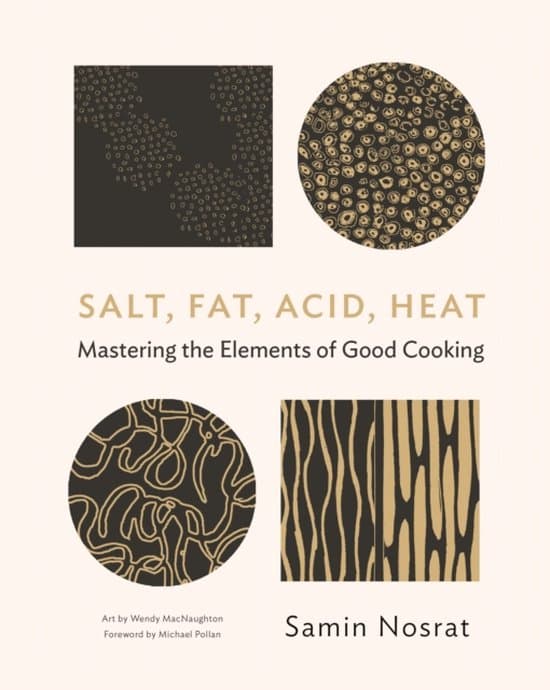
Salt, Fat, Acid, Heat
Mastering the Elements of Good Cooking
Samin Nosrat, Wendy MacNaughton & Michael Pollan480 pages
CookCook makes your cookbooks easy to use.
Create a free account- Search every recipe in your books by ingredient or name
- Make grocery lists and send them to your iPhone
- Capture instructions from your book’s page with the iPhone app
- Collect recipes you want to cook, and tick off what you’ve cooked
215Salads
- 226Vietnamese cucumber salad
- 227Shaved carrot salad with ginger and lime
- 228Shaved fennel and radishes
- 229Summer tomato and herb salad
- 231Summer: tomato, basil, and cucumber
- 232Autumn: roasted squash, sage, and hazelnut
- 234Winter: roasted radicchio and roquefort
- 235Spring: asparagus and feta with mint
- 236Torn croutons
238Dressings
Join for free to see all 104 recipes
- Search this book by ingredient and title
- Collect your favourite recipes
- Make grocery lists
Popular recipes
Is this book for you?
Best fit forHome cook
- Home cook5/5Fit 5 out of 5
Gets a little better every year
This is the book that explains the why you have been chasing: Chicken stock, Basic mayonnaise and All-butter pie dough are written as master methods with their variations laid out beside them, so every one carries over into the next thing you cook. The chapters on salt timing, rendering fat and balancing acid are the technique you would otherwise piece together from a dozen other books, and the recipes read as tested by someone who has taught them to novices and watched where they fail. There is no restaurant plating and nothing you cannot do on a domestic stove, only a weekend of confits and braises waiting for you, which is exactly the kind of project you want.
Start with Chicken stock
- Light and healthy4/5Fit 4 out of 5
Light, colourful, balanced
Avocado and Citrus Salad, the shaved fennel and carrot salads and a Herbed yoghurt that stands in for cream are exactly the bright, colourful plates you want to cook for friends and photograph before anyone sits down. The lessons on acid and salt will do more for your everyday grain bowls and salmon than any single recipe, and the herb salsas make the same vegetables taste different every night of the week. The chicken confit, mayonnaise and fried pages are treats rather than routine, but Buttermilk panna cotta is the sort of light dessert you will actually leave room for.
Start with Avocado and Citrus Salad
- Beginner4/5Fit 4 out of 5
Has never fried anything
This is a book that explains before it instructs, with illustrated walkthroughs and a plain reason behind every step, so something as small as a Lemon vinaigrette teaches you why food tastes flat and how to fix it. The salads, soups and simple pastas use short shopping lists and ordinary tools, and the recipes are written as variations on a few methods, which means a second attempt is easier than the first. Leave Beer-battered fish and All-butter pie dough until you have a few successes behind you, because deep frying and pastry are where things go wrong fastest and the book will not slow down for you there.
Start with Lemon vinaigrette
- Parent of young kids4/5Fit 4 out of 5
Has to survive a toddler and a late dinner
Tomato: pasta alla pomarola, the buttermilk biscuits, kufte kebabs and a Chicken pot pie are familiar shapes your children will actually eat, and the sauces, stock and braises reheat well enough to survive a bedtime that runs late. Keep an eye on the chilli-forward dishes like the pork braise and spicy fried chicken, where you can halve the heat or serve the chilli on the side, and skip the few dishes that need everyone at the table the moment they are done. For after bedtime, Chicken with vinegar and the herb salsas give you something sharp and grown-up from the same shopping trip.
Start with Tomato: pasta alla pomarola
- Flavour maximalist4/5Fit 4 out of 5
Chilli, anchovy and lemon on everything
Harissa, muhammara, chimichurri, charmoula and a whole chapter of herb salsas give you a shelf of condiments to throw at anything tame, and the Caesar dressing, pork braised with chillies and chicken with vinegar show that the author understands anchovy, heat and sharp acid as well as you do. The real argument of the book, that salt and acid are what make food taste of itself, is your argument too, and it will make you more precise about the bold flavours you already love. A few pages are too polite for you, Pasta alfredo and the panna cotta among them, but you already know which jar from the back of the book to spoon over them.
Start with Harissa
- New-flavour explorer4/5Fit 4 out of 5
Something unfamiliar on every page
Muhammara, a Miso-mustard dressing, the Persian frittata and a dessert instruction as simple as Roast it on a bed of fig leaves will put several things in front of you that you have not cooked before, and the book introduces them one element at a time so you are stretched rather than lost. The real discovery is the framework itself: once you have read the acid chapter you will start seeing vinegar, citrus and yoghurt as interchangeable tools and inventing your own variations, which the recipe list openly encourages. The pantry demands stay modest, pomegranate molasses and a pepper paste or two rather than a cupboard full of single-use jars, though the new techniques land faster than the new ingredients do.
Start with Muhammara
- Restaurant lover4/5Fit 4 out of 5
Wants to eat out at home
You get something more useful than borrowed restaurant glamour here: explanations of flavour and texture that can sharpen your own cooking decisions. Slow-roasted salmon and Meyer lemon salsa give you a main and a sauce worth building a dinner-party plate around, without promising a chef’s exact presentation. Buttermilk panna cotta supplies the finish, though the book’s home-kitchen focus means you should come for technique rather than elaborate composed dishes.
Start with Slow-roasted salmon
- Flexitarian4/5Fit 4 out of 5
Mostly vegetarian, most of the time
Of 104 recipes, 77 are vegetarian (36 vegan), 8 have fish and 19 have meat
You can build proper meatless dinners here, rather than spend the week assembling side salads: Tuscan bean and kale soup and Vegetable: pasta with broccoli and bread crumbs both earn their place. The explanations of seasoning and heat also suit you if you want vegetables to succeed on their own merits, not imitate meat. Crispest spatchcocked chicken gives your occasional meat dinner a clear destination, although the substantial poultry selection takes space you might prefer devoted to more pulse-based mains.
Start with Tuscan bean and kale soup
- Wine lover and Italophile3/5Fit 3 out of 5
Every page calls for a bottle
You will find a proper Italian backbone here, from Meat: pasta al ragù to Pasta alle vongole and a Tuscan bean and kale soup that begs for a Chianti, all treated with the patience you want for a long evening at the table. The trouble is that not a single bottle is suggested anywhere, and the Italian dishes sit beside Persian rice, Vietnamese salads and a run of Japanese-ish and Mexican-ish salsas that will leave you reaching for your own cellar notes rather than hers. Come for the technique behind the regional classics and accept that the pairing, and much of the provenance, is yours to supply.
Start with Meat: pasta al ragù
- Quick weeknight cook3/5Fit 3 out of 5
Thirty minutes, one pan
On a Tuesday you can lean on Cheese: pasta cacio e pepe, Steamy sauté: garlicky green beans and the shaved salads, all of which are a few supermarket ingredients and one pan, and the dressings will rescue whatever is already in your fridge. You will have to skip past a lot, though: Chicken confit, tuna confit, brined turkey and the stock-based soups are weekend or overnight work, and the book is more interested in explaining why than in telling you how long each thing takes. Buy it for the quick building blocks and the odd showpiece, not for a week of dinners planned for you.
Start with Cheese: pasta cacio e pepe
- Old-school meat lover3/5Fit 3 out of 5
Meat, fire and patience
19 of 104 recipes have meat, 8 fish
Pork braised with chillies and Crispest spatchcocked chicken are the kind of slow, patient, properly seasoned meat cooking you respect, and the explanation of brining and salting ahead will improve every roast you do. But be clear about the shape of it: the meat section is mostly a dozen ways with chicken plus one pork braise, Kufte kebabs and a turkey breast, with no beef roast, no lamb shoulder, no offal and no sausage work to speak of. The rest of the book is salads, dressings, vegetables and pastry, so you will be paying for a lot of pages you will never turn.
Start with Pork braised with chillies
- Fitness-minded3/5Fit 3 out of 5
Protein, meal prep, no excuses
Spicy brined turkey breast and Slow-roasted salmon are Sunday meal-prep gold, lean protein that keeps for days and tastes of something, and the Persian frittata and bean soup cover your eggs and pulses without fuss. The ratio is against you elsewhere: a fat chapter that means it literally, mayonnaise and aioli, fried chicken, pie dough and twenty pages of desserts that you will only open on a cheat day. Plan that cheat around Spicy fried chicken, then go back to the salads and dressings, which are where the book earns its place in a training week.
Start with Spicy brined turkey breast
- Student on a budget3/5Fit 3 out of 5
One pan, little money
Tuscan bean and kale soup, the egg drop soup, Persian rice and Vegetable: pasta with broccoli and bread crumbs are big, cheap batches built on beans, eggs and pasta, and the dressings turn whatever is reduced in the vegetable aisle into dinner. What costs you is the fat chapter taken literally: Tuna confit and chicken confit need bottles of good olive oil, the clam pasta and salmon are not student proteins, and a few sauces assume a blender or a thermometer you probably do not own. Treat it as a long-term investment in knowing how to season rather than a book of cheap recipes, and you will get your money back over the years rather than this term.
Start with Tuscan bean and kale soup
- Traveller3/5Fit 3 out of 5
Tastes the city before arriving
The Iranian pages are where the book has a pulse of place: Kuku sabzi: persian herb and greens frittata, Adas Polo o Morgh and the beetroot yoghurt come with a family behind them, and the Tuscan soup and ragù carry the author's years in a Berkeley kitchen cooking Italian food. Elsewhere the hyphens give the game away, with Persian-ish rice, a Japanese-ish herb salsa and Southeast Asian-ish and Mexican-ish versions that are deliberately about technique rather than any market or neighbourhood you could visit. If you want to relive a specific street you will go hungry, but as a way to understand what the cooks you met abroad were doing with salt and acid, it travels better than it first appears.
Start with Kuku sabzi: persian herb and greens frittata
- Low carb3/5Fit 3 out of 5
Few carbs, lots of flavour
Of 104 recipes, 77 are vegetarian (36 vegan), 8 have fish and 19 have meat
You have plenty to work with in the eggs, fish, meat and dressings, but this is a book to select from rather than follow indiscriminately. Start with Kuku sabzi: persian herb and greens frittata, then look to Slow-roasted salmon and Tahini dressing for more promising low-carb territory. The rice, pasta, pastry and sweet offerings leave a substantial share outside your routine, and titles alone cannot settle the carbohydrate count of the sauces and glazes.
Start with Kuku sabzi: persian herb and greens frittata
- Vegan health foodie2/5Fit 2 out of 5
Plant-based, fresh and fuss-free
36 of 104 recipes are vegan, another 77 vegetarian
The salad and vegetable pages are your territory, with Roast: butternut squash and brussels sprouts in agrodolce, a Tahini dressing and a whole run of herb salsas and pepper pastes that are plant-based as written, and the lessons on acid and salt will sharpen anything you already cook. Beyond that you are swapping constantly, because the book is built on butter, mayonnaise, cream, cheese and a long chicken chapter, with Chicken confit cooked in fat as its proud centrepiece and no vegan labelling anywhere to help you skim. Treat it as a technique manual you raid for the vegetable methods and dressings rather than a book that puts vegetables at the centre of the plate.
Start with Roast: butternut squash and brussels sprouts in agrodolce
Written by CookCook with AI from the titles of all 104 recipes in this book and the publisher's description; the numbers come from our own analysis of the recipes, not from the AI.
A visionary new master class in cooking that distills decades of professional experience into just four simple elements, from the woman declared "America's next great cooking teacher" by Alice Waters. In the tradition of The Joy of Cooking and How to Cook Everything comes Salt, Fat, Acid, Heat, an ambitious new approach to cooking by a major new culinary voice. Chef and writer Samin Nosrat has taught everyone from professional chefs to middle school kids to author Michael Pollan to cook using her revolutionary, yet simple, philosophy. Master the use of just four elements—Salt, which enhances flavor; Fat, which delivers flavor and generates texture; Acid, which balances flavor; and Heat, which ultimately determines the texture of food—and anything you cook will be delicious. By explaining the hows and whys of good cooking, Salt, Fat, Acid, Heat will teach and inspire a new generation of cooks how to confidently make better decisions in the kitchen and cook delicious meals with any ingredients, anywhere, at any time. Echoing Samin's own journey from culinary novice to award-winning chef, Salt, Fat Acid, Heat immediately bridges the gap between home and professional kitchens. With charming narrative, illustrated walkthroughs, and a lighthearted approach to kitchen science, Samin demystifies the four elements of good cooking for everyone. Refer to the canon of 100 essential recipes—and dozens of variations—to put the lessons into practice and make bright, balanced vinaigrettes, perfectly caramelized roast vegetables, tender braised meats, and light, flaky pastry doughs. Featuring 150 illustrations and infographics that reveal an atlas to the world of flavor by renowned illustrator Wendy MacNaughton, Salt, Fat, Acid, Heat will be your compass in the kitchen. Destined to be a classic, it just might be the last cookbook you'll ever need. With a foreword by Michael Pollan.